

HOW DOES THE HUMAN™ SYSTEM WORK?
Explaining this inner architecture to the human being is “the most difficult profession in the world"
The human being is a system that constructs its own reality through Perception, Emotion, and Identity. Explaining this inner architecture to the human being is “the most difficult profession in the world.” RPM™ — the Reality Perception Matrix — is entirely dedicated to understanding and explaining this process.
Traditional approaches generally explain difficulty in terms of technical complexity, physical effort, or mental workload. The RPM™ model, however, argues that understanding the human being—and explaining the human being to another human being—is the most complex process underlying every profession.
The human being is not merely a biological organism. The human is a multidimensional system of consciousness that operates through perception, emotion, and identity, continuously reconstructing itself.
For this reason, explaining the human being to the human being is not simply the transmission of information. It is a form of consciousness engineering that enables individuals to recognize their own inner architecture.
1. INTRODUCTİON
Throughout human history, religions, philosophies, psychology, education, art, and politics have all revolved around the same fundamental question:
Who is the human being, and how does the human system operate?
Yet the answer has largely remained unresolved.
Humanity has demonstrated extraordinary success in producing technology, but has not achieved the same success in understanding itself or generating meaning.
The atom has been split. Space has been explored. Artificial intelligence has been developed. Yet humanity still does not fully understand why people fear, love, fight, or repeatedly live through the same behavioural and emotional cycles.
At this point, the RPM™ system proposes a different approach: The human being is not merely a living body, but a biological operating system that produces reality.
Understanding the human being therefore does not mean merely interpreting behaviour. It means decoding the core system that produces that behaviour.
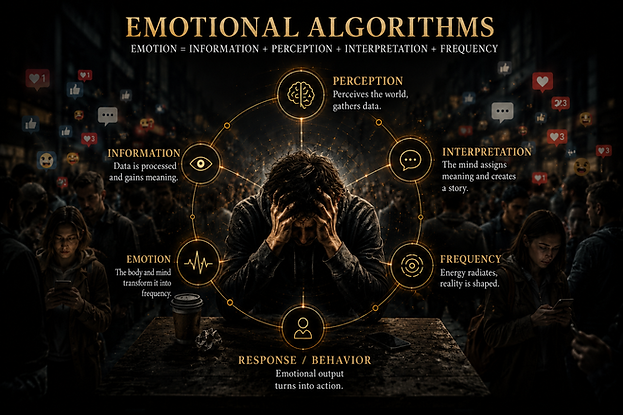

2. THE HUMAN MODEL ACCORDİNG TO THE RPM™ SYSTEM
The RPM™ approach examines the human being through three fundamental cores:
LAYER FUNCTİON
Perception Interprets reality
Emotion Generates energy
Identity Creates direction and guides decisions
These three structures do not operate independently.
Human beings generate emotions according to how they perceive the external world. Over time, the emotions they repeatedly produce contribute to the construction of identity.
Therefore, the reality experienced by the human being is found:
• Not solely in the events themselves,
• But in the mental and emotional processing of those events.
According to the RPM™ system, the human being is a self-learning operating system that is:
• Shaped through environmental programming,
• Rewritten through experience,
• Capable of producing reality according to its level of consciousness.
3. WHY IS EXPLAİNİNG THE HUMAN BEİNG SO DİFFİCULT?
Explaining a machine is relatively easy because its limits, components, and operating rules are clearly defined.
The human being, however, is a contradictory system capable of being:
• Rational and irrational at the same time,
• Loving and destructive,
• Conscious in one moment and automatic in the next.
For this reason, explaining the human being to the human being requires more than knowledge. It requires:
• Awareness,
• Empathy,
• Systemic interpretation,
• The ability to read inner patterns,
• The analysis of consciousness.
According to the RPM™ system, this is the most difficult profession in the world because human beings:
• Cannot easily observe themselves objectively,
• Live without recognizing their own inner codes,
• Are often unaware of the mental programming directing their lives.
Therefore, a person who attempts to explain the human being to another human being must be more than a teacher.
They must also become an architect of consciousness.
4. THE PROBLEM OF THE PROGRAMMED HUMAN BEİNG
When a human being is born, they carry a pure core structure.
Over time, however, this core becomes programmed by:
• Family,
• Society,
• Education,
• Religion,
• Media,
• Trauma and past experience.
As a result, the individual may begin to live not through their authentic essence, but through the programming imposed upon them.
This condition has created one of the central crises of the modern age:
Human beings believe they are living as themselves, while often merely repeating their programs.
For this reason, the RPM™ model differs from conventional approaches to personal development.
Its purpose is not merely:
• To motivate the individual,
• To offer temporary encouragement,
• Or to create a more positive self-image.
Its deeper purpose is:
• To reveal the core system,
• To make unconscious programming visible,
• To help individuals reinterpret and reconstruct their inner architecture.
5. CONCLUSİON
According to the RPM™ system, the most difficult task in the world is:
Explaining the human being to the human being.
This is because the human being is simultaneously:
• The observer,
• The observed,
• And the system producing its own reality.
Understanding the human being requires more than reading the body. It requires reading consciousness.
Explaining the human being to the human being therefore means more than transferring knowledge. It means creating a field of awareness in which individuals can see themselves again from a clearer and more conscious perspective.
For this reason, the greatest need of the future may not be only technology specialists, but architects of the human system.
Humanity’s true evolution may begin not on the day it conquers the external world, but on the day it deciphers its own inner operating system.
Ultimately, human architecture means first understanding oneself and then learning to manage oneself consciously.
Because the human being is a living and continuously changing system operating between emotion, ego, fear, consciousness, and self-interest.